Chatbot vs Conversational AI: Chatbots Resolve 20% of Queries. Conversational AI Resolves 80%. Here's the Difference.
Why Chatbots Resolve 20% of Queries and Conversational AI Resolves 80%
The number isn't arbitrary. It's the result of a fundamental technical difference between two technologies that, from the outside, can seem similar — both answer questions, both operate in messaging channels, both reduce the load on the support team — but that work in radically different ways under the hood.
A traditional chatbot operates on a predefined decision tree. Every possible response was anticipated and programmed before the system went live. If the user's query fits one of those paths, the chatbot responds correctly. If it doesn't — if the user writes something unexpected, asks a question outside the flow, or mixes two topics in the same message — the system hits a dead end and escalates to the human team.
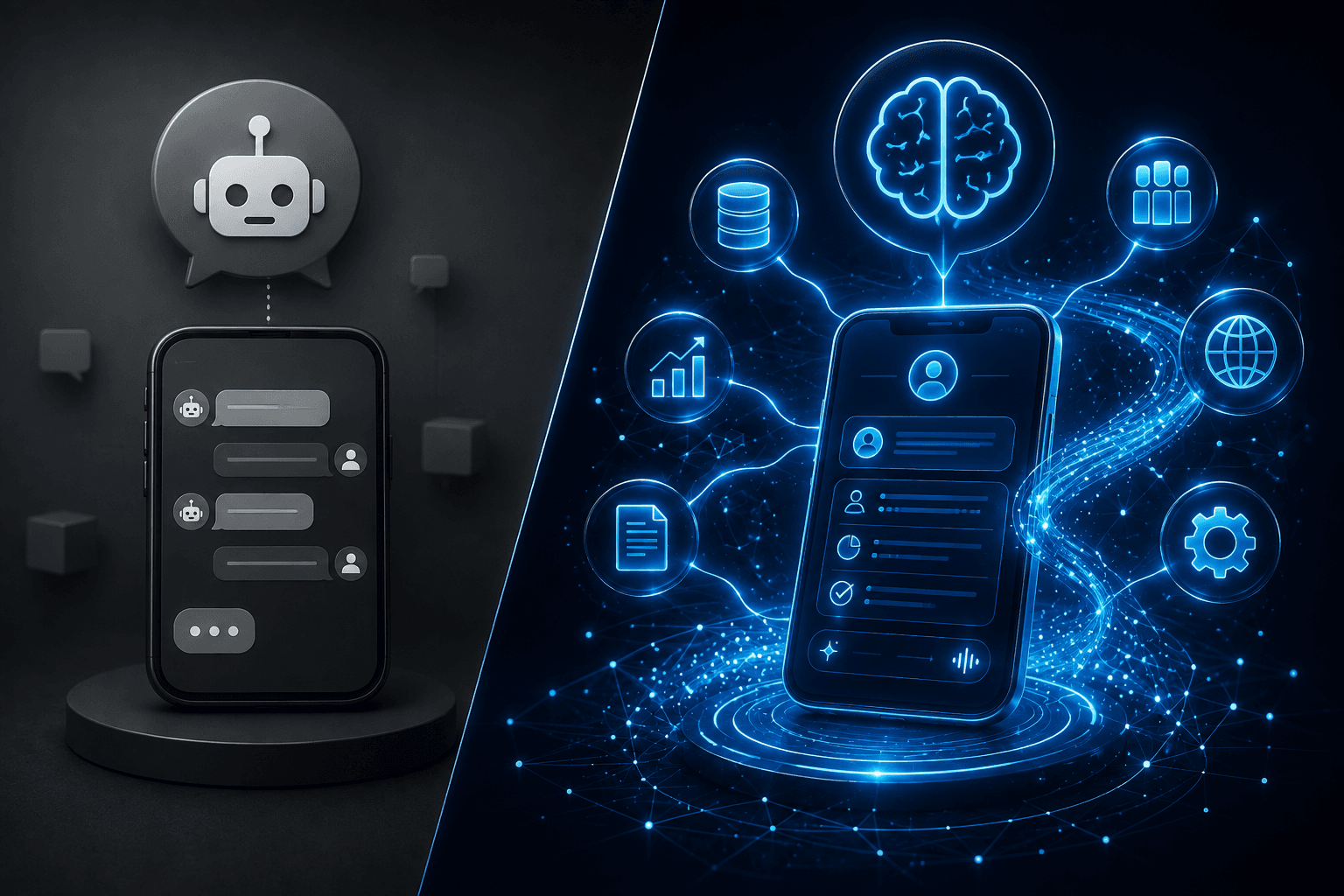
A conversational AI assistant operates on language models that understand context, intent, and natural language variation. It doesn't need the question phrased in exactly the anticipated way. It can interpret what the user is asking even if they say it ten different ways, maintain context across multiple conversation turns, and combine information from different sources to generate a useful response even to never-anticipated queries.
That technical difference is what produces the difference in resolution rates. The 20% a chatbot resolves is the percentage of queries that fit perfectly into predefined flows. The 80% conversational AI resolves comes from handling not just those flows, but all the variability, ambiguity, and complexity of real language.
How a Traditional Chatbot Works — and Why That Defines Its Limit
A classic chatbot is built by mapping the most frequent customer questions and programming a response for each. The process involves defining intents, associated keywords, and the responses or actions to execute when the system detects that intent.
When the user types "what are your business hours?", the system detects "hours", maps it to the correct intent, and returns the programmed response. If the user types "hey, are you guys open right now?", the system may or may not detect the correct intent, depending on which variations were anticipated during design.
The structural limit of this model is that all possible variations of a query must be anticipated and programmed in advance. That works reasonably well for a limited set of very frequent, predictably phrased questions. It breaks down when:
- The user combines two topics in the same message ("can I change my order and also do you ship to Miami?")
- The user asks a question that was never anticipated
- The user asks a follow-up that depends on earlier conversation context
- The user writes with typos, slang, or informal register not accounted for
- The correct response depends on the user's profile or history
In all those cases, the chatbot escalates to the human team. Since those situations represent the majority of real conversations, the autonomous resolution rate stays low.
How Conversational AI Works — and Why It Can Handle What a Chatbot Can't
A conversational AI assistant doesn't operate on a decision tree. It operates on language models trained on enormous volumes of text, enabling them to understand message meaning regardless of phrasing, maintain conversation context over time, and generate coherent, useful responses to questions that were never explicitly programmed.
The most important difference isn't that it "understands more questions." It's that it can reason about conversation context. If in the first turn the user mentioned buying a product last week, and in the third turn they ask "can I return it?", the system knows "return it" refers to that product. A chatbot without context memory treats that question as if it were the first.
Additionally, conversational AI can integrate with company systems — CRM, order database, ticketing, product catalog — to personalize responses in real time. Instead of responding "the return period is 30 days" generically, it can respond "your August 3rd order is within the return window, you can start the process here."
That ability to combine natural language understanding, context memory, and business data integration is what produces significantly higher resolution rates than predefined flow-based systems.
Chatbot vs Conversational AI: Comparison Table
| Dimension | Traditional Chatbot | Conversational AI |
|---|---|---|
| Underlying technology | Decision trees and predefined rules | Language models (LLM) and natural language processing |
| Language understanding | Detects programmed keywords and patterns | Understands intent, context, and natural variation |
| Conversation memory | Limited or none between turns | Maintains context throughout the entire conversation |
| Autonomous resolution rate | 15–25% | 65–85% |
| Unanticipated queries | Escalates to human agent | Attempts to resolve; escalates with context when it can't |
| User personalization | Limited to predefined form fields | Integrable with CRM, history, and real-time data |
| Languages and variations | Requires separate configuration per language | Handles multiple languages and registers natively |
| Maintenance | High: each new query type requires manual updates | Low: the model generalizes without reprogramming |
| Best use case | Very narrow, predictable flows | General service, support, sales, complex queries |
The Same Query, Two Technologies: Real Operational Examples
Scenario 1: query with accumulated context. The user writes: "I bought a jacket last week. It arrived with a broken seam. What do I do?"
- Chatbot: detects "problem" and shows the standard returns flow. If the user doesn't follow the expected path, it can't continue without human intervention.
- Conversational AI: identifies this as a manufacturing defect — different from the standard return process — requests the order number, verifies in the system, and automatically generates the warranty ticket.
Scenario 2: question outside the predefined flow. The user writes: "Does the new sneaker model that dropped this week come in size 12?"
- Chatbot: doesn't recognize the query. Returns: "I didn't understand your question. Can you choose one of these options?" and shows the main menu.
- Conversational AI: checks the catalog in real time and responds with size availability. If size 12 isn't available, offers alternatives or notifies when back in stock.
Scenario 3: follow-up with prior context. Two messages ago the user wrote: "I want to place an order for 50 units." Now they ask: "How long does delivery take?"
- Chatbot: without context memory, returns standard shipping timelines without considering this is a wholesale order.
- Conversational AI: remembers the 50 units, applies wholesale order logic, and responds with the correct timeline for that volume.
When a Chatbot Makes Sense — and When Conversational AI Is the Right Choice
A traditional chatbot makes sense when:
- Queries are very narrow and predictable (e.g. a booking system with fixed fields)
- The interaction flow is always the same and doesn't require natural language understanding
- The range of query types is small and stable over time
Conversational AI makes sense when:
- Queries are varied and require context understanding
- Users phrase the same question in many different ways
- The correct response depends on the user's profile or history
- The company wants high autonomous resolution without growing the support team
- The support channel receives queries in multiple languages or registers
In general, any company receiving more than 50 daily customer queries with significant variability will get a noticeably higher return from conversational AI than from a traditional chatbot. The differential in autonomous resolution rate justifies the difference in initial investment in virtually every case.
How Clarika Implements Conversational AI Assistants
Clarika designs and implements conversational AI assistants for companies in Latin America and the United States. The starting point isn't choosing a platform — it's understanding the company's query profile, identifying what percentage can be resolved autonomously, and designing a system that maximizes that rate without degrading the user experience.
The process includes analyzing existing conversation history to identify frequent patterns, designing the response and escalation logic, integrating with company systems — CRM, order database, product catalog, ticketing — and configuring the assistant in the channels the company already uses: WhatsApp, the website, Instagram, or others.
The objective of every implementation is measurable: increase the autonomous resolution rate, reduce average response time, and free the human team for queries that genuinely require judgment.
If you want to understand what autonomous resolution rate your company could reach with a conversational AI assistant, let's talk.
Frequently Asked Questions About Conversational AI and Chatbots
What is the main difference between a chatbot and a conversational AI assistant?
A chatbot operates on predefined flows and rules — it can only respond to queries that were anticipated and programmed in advance. A conversational AI assistant operates on language models that understand meaning and context, handle unanticipated variations, and maintain the conversation thread. That difference translates directly into resolution rate: 15–25% for chatbots, 65–85% for well-implemented conversational AI.
Why do chatbots have such a low resolution rate?
Because natural language is inherently variable. Users don't always phrase questions the way anticipated during chatbot design. When a query doesn't fit a predefined flow — due to vocabulary, combining topics, or context-dependent follow-ups — the chatbot can't resolve it and escalates to a human agent. Since that variability is the norm in real conversations, the autonomous resolution rate stays low.
Does a conversational AI assistant completely replace the human support team?
Not the goal, nor the most common outcome. The assistant autonomously resolves 65–85% of queries, and the human team focuses on the rest: complex situations, conflicts, cases requiring authorization or judgment. The result is that the same team can handle significantly more volume without degrading service quality.
How long does it take to implement a conversational AI assistant?
A basic implementation can be live in four to six weeks. An implementation with CRM integration, order database, and advanced escalation logic typically takes two to four months. The factor that most affects the timeline is availability of existing conversation history and access to company systems for integration.
Does conversational AI handle regional language variations and slang?
Yes. Current language models handle language in its various regional variants natively — including slang, abbreviations, and common spelling errors. Unlike traditional chatbots, which require separate configuration for each variation, conversational AI generalizes natively to different registers and language variants.
Written by Manuel Aliaga, CEO & Co-Founder at Clarika.
About this article
Category
AI Transformation
Published
August 18, 2026
Reading time
10 min read
Ready to transform your business?
Talk to our team about AI and software solutions tailored to your industry.
Book a Discovery CallMore articles