Most Companies Don’t Need Another Chatbot. They Need a System That Can Act.
For years, conversational technology occupied a very specific place inside digital transformation strategies. It was introduced as a support layer designed to improve accessibility, reduce service costs, shorten response times, and absorb repetitive interactions that traditionally required human attention.
The proposition appeared compelling. If users could simply ask for what they needed instead of navigating systems, everyone would benefit.
Companies would operate more efficiently.
Customers would receive faster answers.
Teams would recover time for higher-value activities.
And to some extent, that happened.
But after several years of implementation across industries, another reality became increasingly visible. Organizations succeeded in creating more conversational experiences without necessarily creating better business experiences.
Customers received answers more quickly but continued encountering delays to actually solve problems. Employees gained access to internal assistants but continued switching between platforms to complete tasks. Businesses introduced chat interfaces that improved interaction metrics while leaving operational friction untouched.
What many companies discovered is that conversation itself was never the objective.
The objective was always reducing effort and creating progress.
That distinction is becoming increasingly relevant now that artificial intelligence is transforming what conversational systems are capable of doing.
Because AI conversational assistants are no longer limited to facilitating communication.
They are beginning to redefine how people access, activate, and move work across organizations.
The First Generation of Conversational Systems Solved Access, Not Execution
The original generation of conversational tools was largely built around availability.
Users should not need to wait.
Information should become easier to retrieve.
Common requests should no longer require human intervention.
From a business perspective, success was frequently measured through operational indicators such as ticket reduction, response time, containment rates, or cost savings.
Those metrics remain valuable.
But they created an unintended consequence.
Companies optimized conversations while underestimating everything that happens after the conversation.
A customer asks to modify an order.
An employee requests internal approval.
A prospect wants to schedule a meeting.
A patient needs to confirm an appointment.
A supplier needs documentation.
In each of these situations, the conversation is only the beginning of the process.
The actual value appears when something happens afterward.
And this is precisely where traditional conversational models started reaching their limits.
Users did not necessarily expect faster responses.
They expected resolution.
That expectation changes the role conversational systems must play.
AI Introduces a Different Model: Conversation as an Operational Layer
Artificial intelligence changes conversational experiences because it introduces capabilities that historically belonged outside the interface.
Instead of only recognizing predefined intents and presenting scripted responses, modern assistants can interpret context, process ambiguity, retrieve information across environments, understand previous interactions, support decision-making, and activate operational actions.
This creates a fundamental shift.
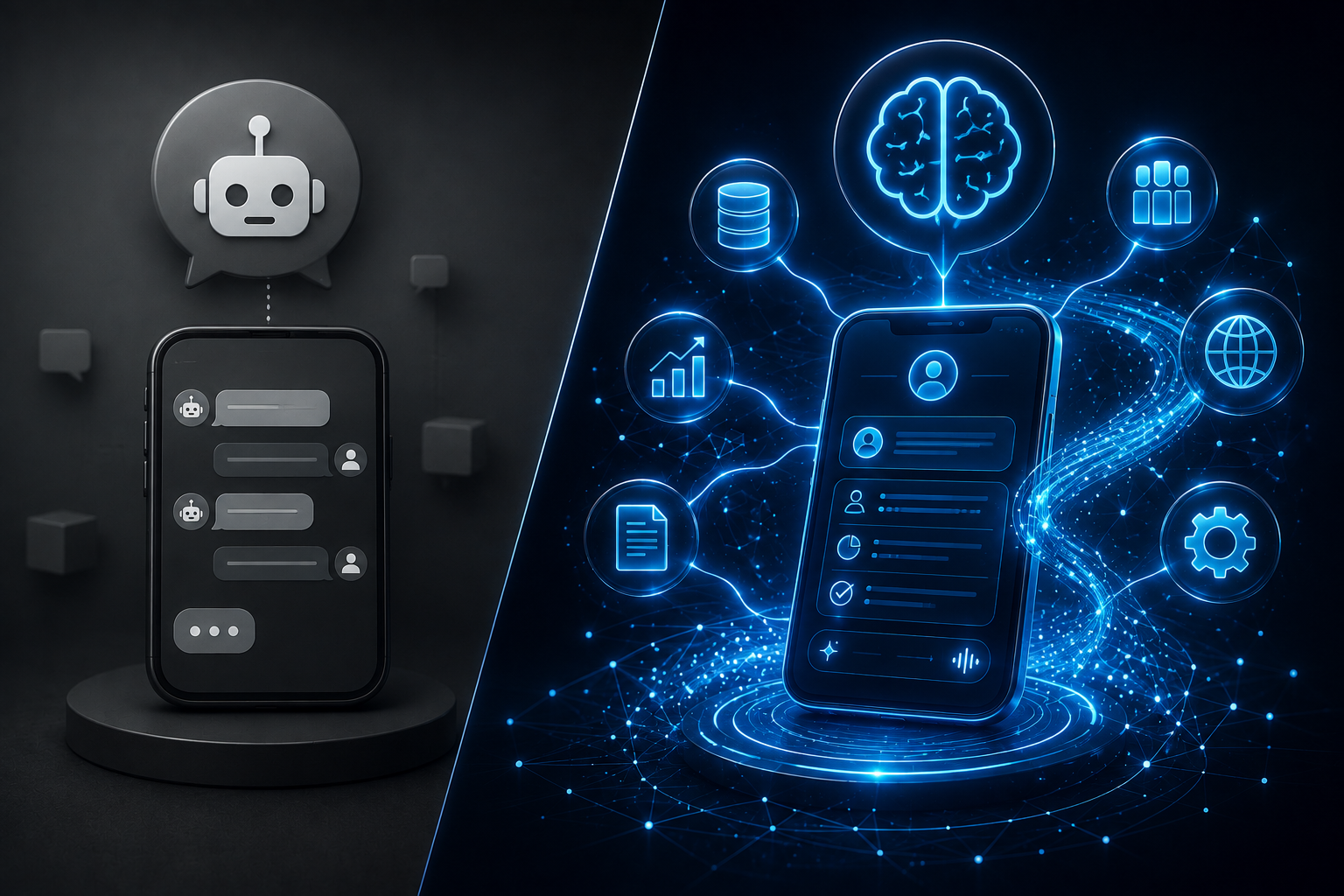
Conversation stops being an endpoint and becomes an operating mechanism.
A request expressed in natural language can become an action executed across systems.
A question can trigger analysis.
A conversation can initiate workflows.
An interaction can generate outcomes.
From the user’s perspective, the experience becomes simpler.
From the organization’s perspective, the architecture becomes significantly more sophisticated.
Because the objective is no longer to create a chatbot that talks.
The objective becomes creating an assistant capable of participating in how work actually happens.
That is a very different design challenge.
Why Many Conversational AI Initiatives Still Generate Limited Business Impact
One of the most common implementation mistakes is beginning with the interface instead of beginning with the operation.
Organizations ask:
Should this live on WhatsApp?
Should this be internal?
Should we deploy voice?
Should this replace support?
Those are relevant questions.
But they rarely determine success.
What determines success is understanding what operational movement should happen once the interaction begins.
What information needs to be available.
Which decisions can be delegated.
Which systems should participate.
Where human intervention creates value.
Where autonomy creates value.
Without that foundation, conversational assistants often become elegant communication layers sitting on top of unchanged processes.
The interaction improves.
The operation does not.
As a result, usage grows while business impact remains difficult to justify.
The technology appears successful.
The outcome does not.
The Most Valuable Assistants Are Not the Ones That Speak Better. They Are the Ones That Understand Context Better.
As conversational interfaces mature, the conversation itself becomes less important than what surrounds it.
Organizations that are creating measurable value are not necessarily investing in assistants with the most advanced language capabilities.
They are investing in assistants connected to business reality.
Assistants that understand operational rules.
Assistants that recognize users and previous decisions.
Assistants that can access internal knowledge.
Assistants that know when to escalate.
Assistants that create continuity instead of isolated interactions.
That shift matters because users rarely judge systems based on technological sophistication.
They judge them based on whether they helped them move forward.
And increasingly, expectations are changing.
People no longer compare conversational assistants with other chatbots.
They compare them with the best digital experiences they have anywhere.
The Next Interface May Not Be Another Screen
For decades, software evolved by adding more layers of navigation.
More menus.
More dashboards.
More configurations.
More places to click.
Conversational AI introduces another possibility.
What if interaction no longer depended on understanding software?
What if software became responsible for understanding people?
That possibility does not eliminate applications or interfaces.
But it changes where complexity lives.
And organizations that understand this shift early are beginning to rethink how customers interact, how employees operate, and how business processes become accessible.
Not through more screens.
Through more intelligent interaction models.
How We Approach AI Conversational Assistants at Clarika
At Clarika, we do not approach conversational assistants as communication projects.
We approach them as operational systems designed to connect people, intelligence, and execution.
That means understanding business objectives before defining channels, understanding operational architecture before defining interactions, and identifying where conversation should generate movement instead of simply generating engagement.
Sometimes that means customer-facing experiences.
Sometimes internal enablement.
Sometimes intelligent support environments.
Sometimes entirely new interaction models.
But the objective remains consistent.
To design assistants that do more than answer.
To create systems that help businesses operate in ways that feel simpler for people and smarter for organizations.
If your company is exploring conversational AI but still evaluating it only as a chatbot initiative, the opportunity may be significantly larger than improving response times.
It may be an opportunity to redesign how people interact with your business.
At Clarika, we help organizations build AI conversational assistants that combine conversation, intelligence, and execution into meaningful operational experiences.
Visit us at: clarikagroup.com
About this article
Category
AI Transformation
Published
July 23, 2026
Reading time
5 min read
Ready to transform your business?
Talk to our team about AI and software solutions tailored to your industry.
Book a Discovery CallMore articles